How Many Miles Is a 2 Hour Hike? A Realistic Guide for Indian Trails
 Oct, 20 2026
Hiking Distance & Time Estimator
Use this tool to estimate your hiking performance. Adjust the sliders to match your planned trail conditions.
Trail Conditions
Estimated Performance
Why is this the estimate?
- Base speed adjusted for terrain.
- Elevation penalty applied (Naismith's Rule).
- Fitness multiplier applied.
- Pack weight penalty applied.
You’re standing at the trailhead in Rishikesh or maybe near Coorg, looking up at a path that disappears into the mist. Your friend checks their watch and says, "It’s just a two-hour hike." You nod, assuming you’ll be back before lunch. But when do you actually get there? Is it three miles? Five? The answer isn't a simple number because your feet don’t measure distance in miles-they measure effort, elevation, and terrain.
Here is the hard truth: how many miles is a 2 hour hike depends entirely on where you are walking. On a flat, paved path in Bangalore, you might cover four miles. On a steep, rocky ascent in the Himalayas, you might only cover one mile. If you plan based on average city-walking speeds, you will likely end up exhausted, lost, or missing your transport back to town.
Quick Summary: What to Expect
- Flat Terrain: Expect 3-4 miles (5-6 km) in 2 hours.
- Moderate Hills: Expect 1.5-2.5 miles (2.5-4 km) in 2 hours.
- Steep/Mountainous: Expect 0.5-1.5 miles (1-2.5 km) in 2 hours.
- Key Factor: Elevation gain slows you down more than distance does.
The Myth of the Average Walking Speed
We often think of walking as a constant activity. We assume if we walk one mile in 20 minutes on the sidewalk, we can do the same on a mountain. This is false. In the world of trekking, especially in diverse landscapes like India, the standard metric used by guides is not miles per hour, but something called Naismith’s Rule. It suggests you allow 1 hour for every 3 miles (5 km) forward, plus an additional 1 hour for every 2,000 feet (600 meters) of ascent.
Let’s break that down for a 2-hour window. If you are hiking in the Western Ghats during the monsoon, the trails are muddy, slippery, and steep. You aren't just moving forward; you are fighting gravity and mud. Here, covering even 1.5 miles in two hours is a solid achievement. Conversely, if you are doing a heritage walk in Hampi, the ground is relatively flat, though uneven due to boulders. You might cover 3 miles comfortably.
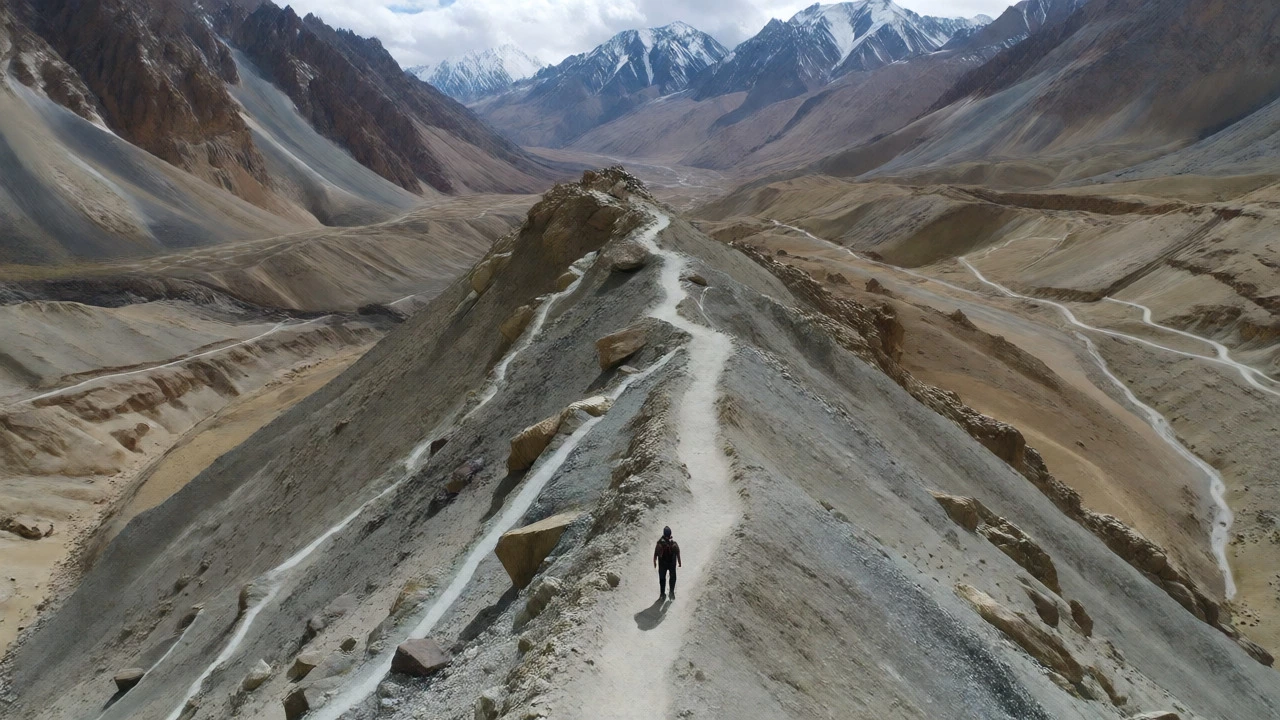
Your fitness level plays a huge role here too. A seasoned trekker from Vancouver might push through a moderate incline faster than a first-time hiker in Kerala. But even experts slow down when the air gets thin. At altitudes above 8,000 feet, such as in Spiti Valley or Ladakh, your body needs more oxygen for every step. Two hours of hiking at 10,000 feet feels physically identical to four hours of hiking at sea level. Do not underestimate altitude fatigue.
Terrain Matters More Than Distance
Imagine two trails labeled "2-Hour Hike." Trail A is a well-maintained gravel path in the Nilgiris with a gentle slope. Trail B is a narrow, root-tangled dirt track in the Sahyadris with loose rocks. Which one takes longer? Definitely Trail B. When calculating how far you will go, look at the surface under your boots.
- Paved/Gravel: High speed. You can maintain a brisk pace. Think of this as 2.5-3 mph.
- Dirt/Forest Floor: Medium speed. Roots and leaves require attention. Think of this as 1.5-2 mph.
- Rocky/Scree: Low speed. Every step requires balance. Think of this as 0.5-1 mph.
- Snow/Sand: Very low speed. Each step sinks. Think of this as less than 0.5 mph.
In India, many popular "easy" treks are actually deceptive. Take the Roopkund trek approach or even shorter walks around Manali. They look inviting from the base camp, but once you start climbing, the gradient hits 15-20%. Your stride shortens. Your breathing deepens. You stop more often to catch your breath. These stops eat into your time budget. If you calculate distance based on continuous movement, you will overestimate your range by nearly 50%.
Elevation Gain: The Silent Time Thief
If you want to know exactly how many miles you will cover, look at the elevation profile, not just the map scale. Climbing up burns significantly more energy than walking flat. For every 1,000 feet of vertical climb, add about 20-30 minutes to your estimated time. This is why a "short" hike in Mussoorie can take forever-it’s all uphill.
Consider a typical weekend getaway scenario in North India. You decide to hike to a nearby waterfall. The map shows the destination is 2 miles away. Sounds easy, right? But the trail starts at 2,000 feet and ends at 4,000 feet. That’s 2,000 feet of gain. Using our rule of thumb, that adds roughly 45-60 minutes of pure climbing effort to the horizontal travel time. So, what looks like a 40-minute walk on paper becomes a 90-minute slog. In a strict 2-hour limit, you might only reach the halfway point.
Conversely, downhill hikes are tricky too. While they are faster than uphill, they are harder on your knees and ankles. You have to move carefully to avoid twisting an ankle on loose stones. So, while you might cover more distance going down, you rarely double your speed. A safe estimate for mixed terrain (up and down) is to average 1.5 miles per hour total.

Contextualizing for Indian Trekking Destinations
India offers vastly different hiking experiences depending on the region. To help you plan, let’s look at specific examples of what a 2-hour hike looks like across different terrains found in the subcontinent.
| Terrain Type | Example Location | Est. Distance (Miles) | Est. Distance (KM) | Difficulty Level |
|---|---|---|---|---|
| Flat/Paved | Hampi Ruins Walk | 3.0 - 4.0 | 5.0 - 6.5 | Easy |
| Gentle Slope/Dirt | Coorg Coffee Plantations | 2.0 - 2.5 | 3.2 - 4.0 | Moderate |
| Steep Forest | Rajgad Fort (Sahyadris) | 1.0 - 1.5 | 1.6 - 2.4 | Hard |
| High Altitude | Kasol to Kheerganga (Upper Part) | 0.5 - 1.0 | 0.8 - 1.6 | Very Hard |
Notice the drastic difference between Hampi and Kasol. In Hampi, the challenge is heat and navigation among ruins, not physical exertion. You can stroll. In Kasol, the challenge is altitude and steepness. You are working hard. If you book a tour that promises a "2-hour trek" in the Himalayas, ask specifically about the elevation gain. If it’s more than 500 feet, expect to cover less than a mile.
Weather and Seasonal Impact
You cannot separate hiking speed from the weather. In October, which is prime trekking season in much of India, the weather is generally favorable. However, local microclimates change everything. A morning fog in Munnar can reduce visibility, forcing you to walk slower to stay on the marked path. Rain in the Western Ghats turns red soil into slick clay. Suddenly, a trail you walked easily last month now takes twice as long because you are slipping.
Heat is another major factor. In places like Rajasthan or central India, hiking in the midday sun drains your energy rapidly. Your pace drops naturally as your body tries to cool itself. A 2-hour hike planned for 10 AM might feel completely different if you start at 2 PM. Hydration breaks also add time. In humid conditions, you need to drink water more frequently. Each stop for water, rest, or adjusting gear eats 5-10 minutes. Over two hours, that could cost you 0.5 miles of progress.
Planning Your Route: How to Calculate Realistically
So, how do you plan without getting caught in the dark? Don’t rely solely on GPS distance tools. Use these steps to create a realistic buffer.
- Check the Elevation Profile: Look at the total vertical gain. Add 1 minute for every 10 feet of gain to your base walking time.
- Assess Trail Conditions: Is it rocky? Muddy? Snowy? Multiply your estimated time by 1.5 for difficult terrain.
- Factor in Stops: Assume you will stop for photos, snacks, and bathroom breaks for 15 minutes total.
- Apply the Safety Buffer: Always add 20% extra time to your final calculation. If you think it will take 2 hours, plan for 2 hours and 24 minutes.
For example, if a map says a trail is 3 miles long with 1,000 feet of gain:
Base time: 3 miles / 2 mph = 1.5 hours.
Climb penalty: 1,000 ft * 1 min/10ft = 100 mins (wait, that's too high. Let's use Naismith: 1 hr per 2000ft. So 1000ft = 30 mins).
Total active time: 1.5 hrs + 0.5 hrs = 2 hours.
Stops/Buffer: +30 mins.
Realistic total: 2.5 hours.
If you only have 2 hours, you won't finish the full 3 miles. You will turn back around the 2-mile mark.
Common Mistakes Hikers Make
One of the biggest errors is confusing "straight-line distance" with "trail distance." Maps often show the crow-flies distance. But trails wind. They zigzag to manage gradients. A straight-line distance of 1 mile might actually be 2 miles of winding switchbacks. Always check the actual trail length on apps like AllTrails or MapMyHike, but remember those apps often underestimate difficulty.
Another mistake is ignoring group dynamics. If you are hiking with children, elderly parents, or friends who don’t exercise regularly, your speed drops drastically. A 2-hour hike with a fit solo traveler might be a 4-hour ordeal for a family group. Communication matters. Agree on a turnaround time, not just a destination. If you haven’t reached the viewpoint by the halfway time marker, turn back. It’s better to see half the view than to miss the bus home.
Final Thoughts on Pacing Yourself
Knowing how many miles is a 2 hour hike helps you respect the mountain and your own limits. It transforms a stressful scramble into an enjoyable experience. Whether you are exploring the lush greenery of the Northeast or the arid landscapes of Ladakh, the golden rule remains: adjust your expectations to the terrain, not the clock. Pack light, wear proper shoes, and always leave room for the unexpected. The trail doesn’t care about your schedule, so you must care about its demands.
Is 2 miles considered a long hike?
Generally, no. For most healthy adults, 2 miles is a short to moderate hike, taking about 45-60 minutes on flat ground. However, if the 2 miles involve significant elevation gain or rough terrain, it can feel like a strenuous workout lasting 2+ hours.
How fast should I hike on uneven terrain?
On uneven or rocky terrain, aim for 1 to 1.5 miles per hour. This allows you to focus on foot placement and balance, reducing the risk of injury compared to trying to maintain a road-walking pace of 3 mph.
Does carrying a backpack affect hiking speed?
Yes, significantly. A heavy pack increases fatigue and reduces stride length. For every 10 pounds of weight, expect your speed to drop by about 5-10%. For a 2-hour hike, keep your pack light-under 15 pounds-to maintain a reasonable pace.
What is the best way to estimate hiking time?
Use Naismith’s Rule as a baseline: 1 hour for every 3 miles plus 1 hour for every 2,000 feet of ascent. Then, adjust for terrain difficulty and personal fitness. Always add a 20% safety buffer for breaks and unforeseen delays.
Can I hike 3 miles in 2 hours?
Yes, if the terrain is relatively flat and you are in decent shape. However, if the trail is steep, rocky, or at high altitude, 3 miles in 2 hours is ambitious and may lead to exhaustion. Check the elevation profile before committing.